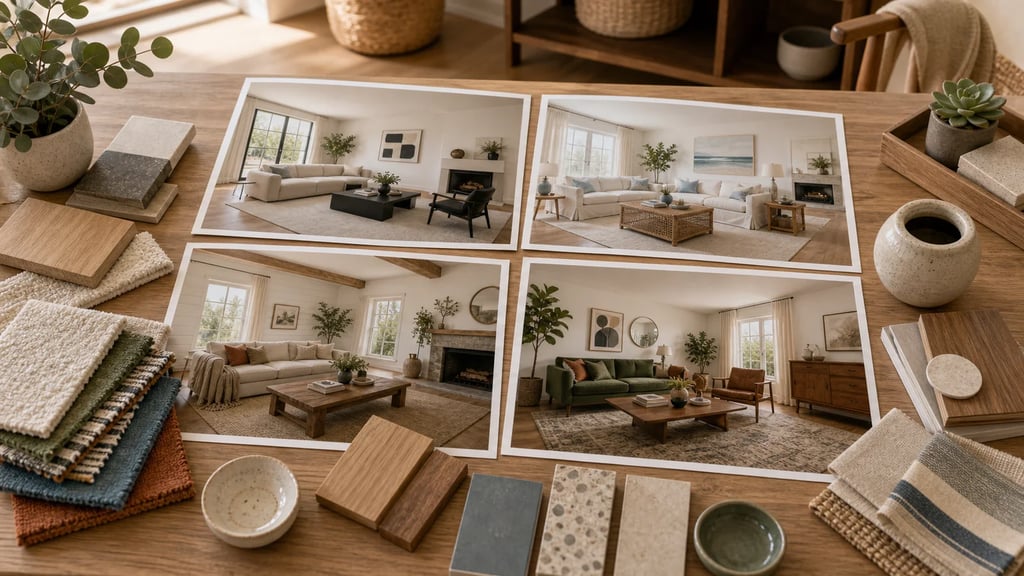
Core Interior Design Style Hubs
| Style | Best For | Start Here |
|---|---|---|
| Modern | Clean lines, neutral spaces, simple furniture | Modern interior design |
| Minimalist | Small rooms, clutter reduction, calm layouts | Minimalist home decor |
| Scandinavian | Light woods, bright rooms, functional comfort | Scandinavian interior design |
| Japandi | Warm minimalism, natural materials, quiet rooms | Japandi interior design |
| Coastal | Relaxed rooms, light palettes, natural textures | Coastal interior design |
| Industrial | Lofts, brick, metal, concrete, darker palettes | Industrial interior design |
| Farmhouse | Warm family spaces and casual rustic comfort | Farmhouse interior design |
| Contemporary | Current, polished, flexible modern rooms | Contemporary interior design |
| Traditional | Classic rooms, symmetry, richer furniture | Traditional interior design |
| Mid-century modern | Vintage modern furniture and warm woods | Mid-century interior design |
| Eclectic | Personal rooms with mixed eras and color | Eclectic interior design |
How to Choose a Style Without Guessing
Read the room before you read the magazines
The fixed parts of a room decide more than any mood board does. Floor color, window size and orientation, ceiling height, trim profile, a fireplace, built-ins, the quality of light at the times you actually use the space. These are the things you're not going to change, so they should lead.
Want to try it now? Use the free AI room design generator to generate style directions for your room before choosing a final look.
Warm wood floors and soft, diffused light lean naturally toward Japandi, Scandinavian, or modern farmhouse. A loft with brick, exposed ducts, and a concrete slab is practically asking for industrial. Crown molding, paneled doors, and a real fireplace give traditional or transitional something to hang onto. Push a style that ignores all this and the result looks like a sticker over the architecture rather than a room.
Decide how the room should feel, not just look
Two rooms can both be technically "modern" and feel like opposite places, one austere and a little cold, the other warm and inviting, depending entirely on color temperature, texture, and how big the furniture is relative to the space. So pick the feeling first:
- Calm and quiet: minimalist, Japandi, Scandinavian
- Relaxed and casual: coastal, farmhouse, cottage
- Polished and composed: contemporary, traditional, mid-century modern
- Warm and layered: bohemian, eclectic, farmhouse
- Urban and textural: industrial, modern, contemporary
Settle on the mood, and the shortlist of styles narrows itself.
Be honest about upkeep
Every style has a maintenance tax, and it's worth knowing the bill before you sign up. Minimalism only reads as calm when the surfaces stay clear, which means it punishes clutter harder than any other look. Coastal goes flat and chilly the moment you skimp on texture. Eclectic slides into mess without a unifying color or material to hold it together. Industrial turns cold without textiles and warm bulbs to soften the hard edges. Factor in pets, kids, how often you actually dust, and how much visual busyness you can live with day to day.
Test styles that are close enough to compare
Don't throw all eleven styles at the wall at once, the results blur together and you learn nothing. Pick two or three that are genuine neighbors, so the differences are about choices you'd really weigh:
- Modern vs contemporary vs mid-century modern
- Minimalist vs Scandinavian vs Japandi
- Coastal vs farmhouse vs cottage
- Traditional vs transitional vs modern classic
- Industrial vs urban vs modern
Run all of them from the same room photo in the AI room design generator and put the outputs side by side. Comparing three versions of your own room beats scrolling through a hundred photos of rooms you'll never stand in.
The Styles, and What Each One Demands
Most guides describe styles by listing what they contain. More useful is knowing what each one needs from you to actually work, and the specific way each one fails.
Modern
Clean lines, simple silhouettes, a neutral base, decor kept on a short leash. Modern is the safe default for living rooms, bedrooms, offices, and open-plan spaces where you want things to feel current and uncluttered. Its failure mode is coldness: strip away ornament without adding warmth and you get a showroom nobody wants to sit in. Bring it back with a wool rug, real wood, linen, and lighting that's warm rather than blue.
Read: Modern interior design
Minimalist
Fewer things, better things. It's the natural fit for small rooms and apartments because it cuts visual noise where space is tight. But "few objects" is not the same as "empty," and the line between calm and barren is thinner than people expect. Closed storage does the heavy lifting, then one clear focal point and a handful of genuinely warm materials, a rug, curtains, soft light, keep it from feeling like a waiting room.
Read: Minimalist home decor
Scandinavian
Light woods, pale walls, practical furniture, textiles that invite you to stay. It flatters small and bright rooms by keeping the palette airy while still feeling lived-in. The classic mistake is going all-white, which drains the warmth that makes the style work in the first place. Wood tone, woven texture, warm-temperature lamps, and a little intentional contrast are what separate cozy from clinical.
Read: Scandinavian interior design
Japandi
Japanese restraint married to Scandinavian warmth: low furniture, natural materials, soft neutrals, and rooms that feel quiet. It's especially strong in bedrooms, living rooms, and bathrooms. Of all these styles it demands the most discipline, because it's defined as much by what you leave out as what you put in. Keep the palette tight, resist filling every surface, and let the empty space carry its share of the design.
Read: Japandi interior design
Coastal
Relaxed, light, and built on texture, not theme. Done well it's soft whites, sand tones, a wash of blue or green, linen, rattan, light wood, easy furniture, and not a single anchor, shell, or "Beach This Way" sign. It lives on natural light. In a dark room, lean on the textures and warmer tones rather than the pale palette, or the whole thing reads washed-out and sad.
Read: Coastal interior design
Industrial
Brick, metal, concrete, leather, darker tones, raw texture left visible. It belongs in lofts, conversions, and rooms with strong bones already. The danger is obvious and one-note: cold. Hard materials need a counterweight, so a thick rug, warm bulbs, upholstered seating, wood, and art keep an industrial room from feeling like a parking garage with a sofa in it.
Read: Industrial interior design
Farmhouse
Warm, comfortable, casual. Modern farmhouse trims the rustic excess of the older version, with cleaner lines and far fewer decorative signs. Wood, warm whites, black accents, woven texture, real storage, and seating you'd actually sink into. The pitfall is letting it tip into theme-park territory, so edit hard and skip the mass-produced "Gather" decor.
Read: Farmhouse interior design
Traditional
Symmetry, classic furniture, richer fabrics, framed art, table lamps, architectural detail. It suits older homes and formal rooms where there's existing character to build on. The version that fails is the one frozen in 1985, all matching sets and stiffness. Slip in a cleaner lamp, a simpler rug, or updated upholstery and the room stays classic without feeling like a museum.
Read: Traditional interior design
Mid-century modern
Low furniture, tapered legs, warm woods, simple silhouettes, graphic shapes. It plays well in apartments, living rooms, dining rooms, and offices. The trap is treating it as a costume, pile on too many period pieces and the room becomes a film set. Cut the vintage with current textiles, contemporary art, and modern lighting so it reads as your home, not a rerun.
Read: Mid-century interior design
Eclectic
A deliberate mix of eras, colors, patterns, and personal pieces, held together by one consistent thread: a repeated color, a shared material, an echoed shape, a steady sense of scale. With that thread, the room feels collected and personal. Without it, eclectic is just the polite word for clutter.
Read: Eclectic interior design
A Workflow That Actually Narrows Things Down
The point of testing styles with AI isn't to admire pretty renders, it's to make a decision. A tight loop:
Shoot one clear, well-lit photo of the room and reuse it for everything, so what changes between images is the style and nothing else. Generate your two or three shortlisted styles from that single photo. Then judge them on the unglamorous stuff: does the wall color help or fight the light, is the furniture scaled believably for the actual room, where does the storage go, does the lighting feel warm. Save the strongest direction, run a couple more variations of just that style to pressure-test it, and only then translate the winner into a concrete list, paint colors, furniture shapes, lighting, rug, textiles.
For the mechanics of all this, see how to use AI for room design and how to design a room with AI.
Worked Example: A Cramped Living Room
Picture a small living room, beige walls, one window, a dark sofa, not enough storage. Starting it on industrial or heavy traditional would be working against the room, both want more mass and more darkness than the space can spare. Scandinavian, warm minimalist, and Japandi are the sensible shortlist.
Generate all three and read them critically. Which one makes the room feel brighter rather than just lighter in color? Is the furniture in each render actually sized for a small room, or has the model quietly fit a sectional that would never get through the door? Does the storage solution survive contact with reality? If the Japandi version looks serene but too sparse to live in, that's not a dead end, it's a clue: borrow its palette and graft on Scandinavian storage. The output is a recipe, not a poster, you're learning what works, not copying one image.
Worked Example: An Older Home
Now a house with original trim, wood floors, and a working fireplace. Force a cold minimalist look onto it and you'll spend the next decade fighting the architecture. Traditional, transitional, and modern classic are the natural candidates here.
If traditional comes back feeling too formal, keep its symmetry and warm materials but swap in simpler furniture. If the contemporary take lands too plain, the fix is additive, classic lamps, framed art, a richer textile or two, until the room has the depth the bones deserve.
The Three Mistakes That Keep Recurring
Fighting the house. A style should cooperate with the room's architecture, not try to erase it, and the room usually wins that fight.
Buying decor before settling layout and furniture scale. A sofa that's the wrong size for the room is not a problem you can pillow your way out of.
Mixing too many styles with no governing rule. Liking several looks is fine, commit to one main style and one secondary influence and stop there. A Scandinavian base with coastal color works. A traditional layout with modern lighting works. Five styles at equal volume just argue with each other.
Related Guides
- Best AI room design tool
- AI room design software
- Room design ideas
- Living room design ideas
- Bedroom design ideas
- Kitchen design ideas
- How to choose paint colors
The best interior design style isn't the one with the buzziest name this year. It's the one that works with the room you already have, the way you actually live, what you're willing to spend, and how you want the space to feel at seven on a Tuesday evening. Test a few against your own photo, be honest about the trade-offs, and let the room tell you which one fits.
