The living room is the room everyone designs first and redesigns most often. It's the primary social space, the one visitors see immediately, and the room that sets the tone for the whole house. It's also the hardest room to get right — because it needs to serve the most functions simultaneously: entertaining, relaxing, watching TV, possibly working, and making the house feel like a home.
AI living room design tools have become genuinely useful because the living room has well-defined design problems that repeat across nearly every home. This guide covers those problems directly: the layout types that work in real conditions, the style guides specific to living rooms, and how AI handles the challenges that trip up most homeowners.
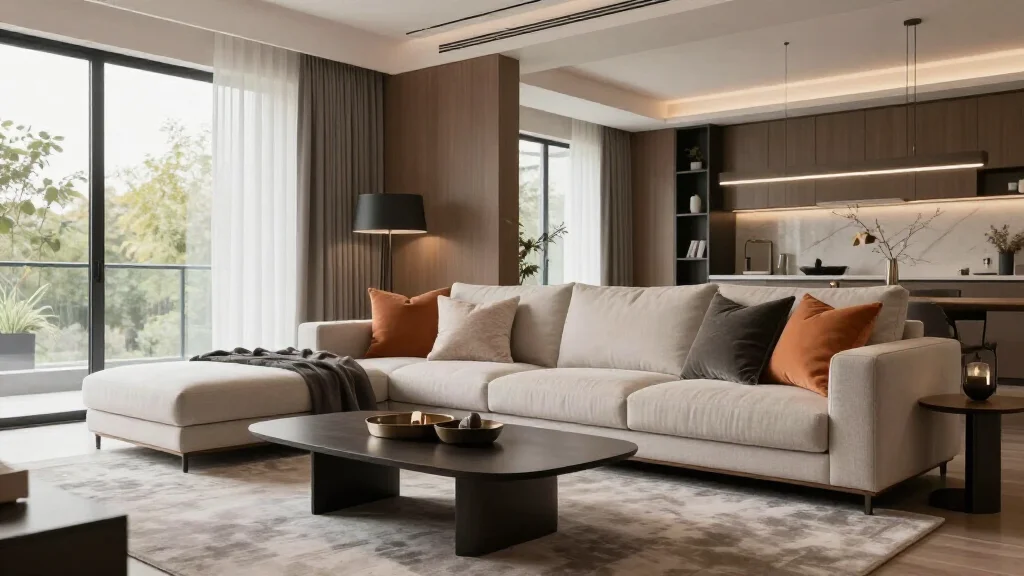
The Four Living Room Types (and What Each One Needs)
Living rooms aren't all the same design problem. The layout that works in one configuration fails in another. Knowing which type you have determines almost everything else.
Type 1: The Open-Plan Living Room
The challenge: No walls to define the space. The living room bleeds into the kitchen, dining room, or entryway, making it hard to create a cohesive space.
What it needs: Zone definition. A rug defines the seating area. Furniture orientation creates a visual boundary. Lighting zones (a pendant over the dining area, floor lamps in the living area) separate the functions visually.
Where AI helps most: AI tools are strong at open-plan zone definition. Upload a photo of your open-plan space and the AI will consistently show you rug placement, furniture orientation, and lighting that define distinct zones without walls. This is harder to visualize manually than any other layout type.
Key rule: The sofa back is the wall. In open-plan spaces, position the sofa so its back faces the kitchen or dining area. This is the primary device for separating the living zone.
Type 2: The Formal Living Room
The challenge: Symmetry and proportion. Formal living rooms are often the most architecturally finished rooms in the house (crown molding, fireplace, built-ins) and the furniture needs to match that quality level.
What it needs: A clear focal point (almost always the fireplace), symmetrical flanking furniture, and restraint. Formal living rooms fail when they're over-furnished.
Where AI helps most: AI is good at flagging scale problems in formal living rooms. If the AI consistently shows fewer pieces than you currently have, the room is over-furnished.
Key rule: One statement piece, everything else supporting. The sofa faces the fireplace. Everything else in the room serves that primary conversation orientation.
Type 3: The Family Room / Casual Living Room
The challenge: Durability and function without looking like a furniture showroom. Family rooms need to handle real use while still looking intentional.
What it needs: Performance fabrics, practical storage, flexible seating (ottomans that work as coffee tables), and lighting that can shift from daytime bright to evening dim.
Where AI helps most: AI tools are good at suggesting layout flexibility — ottomans, modular seating, and storage-built-in furniture that humans often don't consider.
Key rule: Test the sofa-to-TV distance. The optimal viewing distance is 1.5x to 2.5x the diagonal screen size. A 65-inch TV needs 8–13 feet of viewing distance. Most living rooms have the TV too close.
Type 4: The Small Apartment Living Room
The challenge: Fitting all the functions of a living room into a space where every square foot counts. The instinct is to buy small furniture — this is usually wrong.
What it needs: Fewer pieces at the right scale. In a small room, a too-small sofa makes the room look smaller, not bigger. One good-sized sofa is better than three small pieces. Vertical space matters: tall shelving, high curtains, and vertical art all make the room taller.
Where AI helps most: AI consistently solves small room scale problems correctly. Upload a photo of a small living room and the AI will usually show you fewer pieces, better-scaled furniture, and vertical elements that open the space. The most common feedback from small-room AI outputs: people are over-furnishing their small rooms with undersized pieces.
Key rule: One sofa, one chair, one coffee table, one rug, done. Resist the side tables, the accent chairs, the console tables. Edit aggressively.
Living Room Style Guides
Different living room types suit different architectural contexts. Here's what each major style actually requires in a living room — not just the aesthetic, but the practical furniture and layout decisions.
Modern / Contemporary
Core furniture requirements: Low-profile sofa with clean lines, no decorative legs on coffee table (slab or hairpin legs), recessed lighting or directional track, minimal window treatments.
What AI shows you: Furniture with strong horizontal lines, a monochromatic palette with one or two accent colors, art as the primary decorative element.
What trips people up: "Modern" doesn't mean cold. Warm modern (warm whites, natural wood, textured neutrals) is more livable than cold modern (grey on grey with chrome). AI tools handle this distinction well — specify "warm modern" or "Japandi" in style prompts.
Scandinavian
Core furniture requirements: Light oak or natural wood legs on all furniture, textural contrast (smooth fabric sofa + wool rug + ceramic vase), white or off-white walls, abundant natural light stressd not blocked.
What AI shows you: Intentional layering of natural materials, plants as a primary design element, and lighting as a design feature (not just function).
What trips people up: Scandinavian design looks simple but requires the right objects. Generic furniture doesn't achieve the aesthetic — it needs specific material qualities (natural linen, real wood, unglazed ceramic).
Mid-Century Modern
Core furniture requirements: Tapered legs on everything (sofa, chairs, side tables, credenza), warm tones (walnut, camel, burnt orange, avocado), statement lighting (Sputnik chandelier, Arco floor lamp), minimal but deliberate art.
What AI shows you: The AI will add a credenza or record cabinet along one wall — the storage piece is a signature element. It will also add a statement rug in a geometric pattern.
What trips people up: Mid-century goes wrong when it becomes pastiche. One or two genuinely mid-century-shaped pieces anchored by more neutral contemporary pieces works better than an all-mid-century room.
Maximalist / Eclectic
Core furniture requirements: No requirement. The constraint is that everything must be intentional — maximalism isn't clutter, it's curated abundance.
What AI shows you: The AI handles maximalist surprisingly well when prompted correctly. Specify "maximalist" plus a color family (e.g., "jewel tones" or "warm earth colors") and the AI will layer patterns and textures coherently. The outputs here are some of the most visually striking the tool produces.
What trips people up: Scale. Maximalist rooms need confident scale — large art, full-height shelving, substantial furniture. Maximalism with timid, undersized pieces just looks messy.
The Hard Problems: What AI Handles That Humans Get Wrong
TV Placement
TV placement ruins more living rooms than any other single decision. The problems AI tools consistently correct:
The over-fireplace TV: Mounting a TV above a fireplace forces a viewing angle that's too steep (typical mounting height of 60–70 inches puts the screen center above comfortable seated eye level at 42–48 inches). Every AI-generated layout that includes both a fireplace and a TV puts them on the same wall rather than stacking them.
The corner TV: Corners force diagonal viewing for most seating positions. AI tools place TVs on flat walls opposite the primary sofa.
The too-high wall mount: AI correctly places TVs with the screen center at 42–48 inches from the floor for seated viewing, not at the "dramatic" position many homeowners choose.
Sectional Sizing
Sectionals are the most frequently over-sized furniture piece in living rooms. The rule is that a sectional should leave at least 36 inches of clearance on all open sides. AI Smart Decor consistently shows right-sized seating for the room dimensions — and frequently shows non-sectional configurations (sofa + two chairs) for rooms that homeowners have convinced themselves need a sectional.
If you're debating a sectional: upload your room to AI. If the AI output shows a regular sofa, your room is telling you something.
Rug Sizing
The most common rug mistake: too small. A rug that only fits under the coffee table while all the sofa legs sit on bare floor creates a floating, disconnected seating area. The right size has at least the front legs of all seating pieces on the rug.
Standard correct rug sizes:
- Room under 12x14 ft: 8x10 rug minimum
- Room 12x18 ft: 9x12 rug minimum
- Large open-plan living room: 10x14 or larger
AI tools consistently choose larger rugs than humans do. Use the AI output's rug proportions as your guide.
Lighting Layering
Living rooms need three types of light: ambient (overall illumination), task (reading, working), and accent (showing art or architectural features). Most living rooms have only one: overhead ambient.
AI-generated living room designs almost always add floor lamps flanking the sofa, a table lamp or two, and often pendant lighting or directional fixtures. If your AI output added floor lamps, that's not stylistic — your room has a lighting problem.
How to Use AI for Living Room Design: Practical Workflow
-
Photograph your current living room from two corners (both diagonal views) plus straight-on shots of each wall. More angles give the AI more to work with.
-
Upload to AI Smart Decor and run through 4–5 style directions. Don't prejudge — let the outputs show you what your room's architecture suits.
-
Note the structural changes in each output: Did the AI move furniture away from the walls? Did it change the TV position? Did it add a rug under the sofa? These are corrections, not style choices.
-
Choose a direction based on the combination of architectural fit and personal preference. The right style for your room is the one where the AI output looks most like it belongs there.
-
Extract a change list. Not "buy this sofa" but "I need a lower-profile sofa with tapered legs in a warm neutral." The AI shows you the shape and scale; you choose the specific piece.
-
Re-generate after major changes. If you repaint or change a major furniture piece, upload a new photo and run it through again. The AI gives you the most accurate guidance when it's working with your current room, not a three-month-old photo.
Living Room Design at Different Budgets
| Budget | What's Achievable | Primary Focus |
|---|---|---|
| Under $200 | Cosmetic refresh | Paint + new throw pillows + rearrangement |
| $200–$500 | Textile and lighting upgrade | New rug, curtains, floor lamp, decor edit |
| $500–$1,500 | One anchor piece replacement | New sofa or primary seating + decor refresh |
| $1,500–$4,000 | Complete furniture refresh | All furniture + lighting + textiles |
| $4,000+ | Professional renovation | Possible layout changes, built-ins, premium finishes |
At every budget tier, AI planning prevents the most expensive mistake: buying the wrong thing.
Start With Your Living Room
The living room has the most at stake and the most complexity. AI tools handle it well precisely because the design rules are consistent and the problems repeat. Upload your photo, let the AI show you what's possible, and use the outputs as your brief.
Design Your Living Room with AI